Good Riddance Govia!
31st May 2026 | News
Today Britain’s biggest private rail operator, Govia Thameslink Railway – which runs all services on Thameslink, Southern and Great Northern – is finally brought back into public ownership.
We’re taking the opportunity to celebrate.
This marks the end of a decade-long campaign to get rid of Govia – the disgraced private company co-owned by the Go-Ahead Group and Keolis, a subsidiary of the French state-owned rail operator SNCF.
The fight was begun by our friends at the Association of British Commuters during the crisis on Southern Rail in 2016 – and continued through the great timetable fiasco of 2018.
In 2022, following a series of scandals with Govia’s neighbouring rail franchise Southeastern, we worked together to take legal action to try to stop the Department for Transport extending Govia’s contract for Thameslink, Southern and Great Northern.
We weren’t successful then, but the momentum we’ve continued to build for a fully publicly-owned railway paved the way for the Labour government’s commitment to establish Great British Railways following the general election in 2024.
Funds raised during our CrowdJustice campaigns have continued to support legal advice on the new Railways Bill, which will create Great British Railways.
The Railways Bill is currently making its way through Parliament, with its 3rd reading in the Commons planned for next Wednesday 10 June 2026.
We are backing a series of amendments aimed at ensuring that Great British Railways is truly run in the public interest, so that passengers, our environment and the economy are always prioritised before private profit.
Ahead for the debate next Wednesday 10 June 2026, please write to your MP to ask them to support the amendments.
And you can see which rail franchises will be next to be brought back into public ownership with our handy Privatisation Departures Board.
Passengers vs Profiteers – ask your MP whose side they’re on
12th April 2026 | Demonstration / News

The Railways Bill – which will create our new Great British Railways (GBR) – will be debated in the House of Commons again soon at its Report Stage.
We’re working with our friends at We Own It to raise awareness for the key problems with the Bill – and to promote the amendments aimed at resolving them.
Please take two minutes to write to your MP to ask them to back these crucial amendments – and come to the ‘Tug of War’ event in Parliament Square on Wednesday:
Tug of War: Passengers vs Profiteers
Wednesday 15 April 2026, 12:45-14:15
Parliament Square, London
(in front of the Nelson Mandela statue)
Railways Bill Committee – the fight for the future of our railways is now on
19th January 2026 | News
This week the Railways Bill – which will establish Great British Railways (GBR) – enters its Committee stage at the UK Parliament. A group of 21 MPs have been selected to scrutinise the legislation line-by-line.
We are working with our friends at the Association of British Commuters and We Own It to raise alarm bells about the key issues with the Bill.
Although the Government claims “GBR will end years of fragmentation and will have a relentless focus on driving up standards for passengers, including simpler fares and ticketing” – this will not happen if the current legislation is allowed to pass.
The Bill actually maintains much of the competition framework from the 1993 Railways Act, which was responsible for the fragmentation and inefficiencies of the privatisation era.
Instead of having one vertically-integrated public body which is responsible for all aspects of the railway and is run this the public interest, this legislation is designed to put the commercial interests of private companies first (open access operators, third-party ticket retailers and rolling stock companies).
Railways Bill Inquiry
11th December 2025 | Evidence / News
On 5 November 2025, the Railways Bill – which will create the new public body Great British Railways – was introduced to Parliament. On the same day, the Parliament’s Transport Committee launched an Inquiry into the Railways Bill and a call for evidence.
We submitted written evidence outlining our concerns with the proposed legislation and the Government’s determination to maintain “An ongoing role for the private sector” in our railways (in ticket retail, open access services and rolling stock). This threatens to completely undermine many of the key benefits of having a fully publicly-owned system.
Passengers not Profit: A vision for the Railways Bill
18th August 2025 | Evidence / News
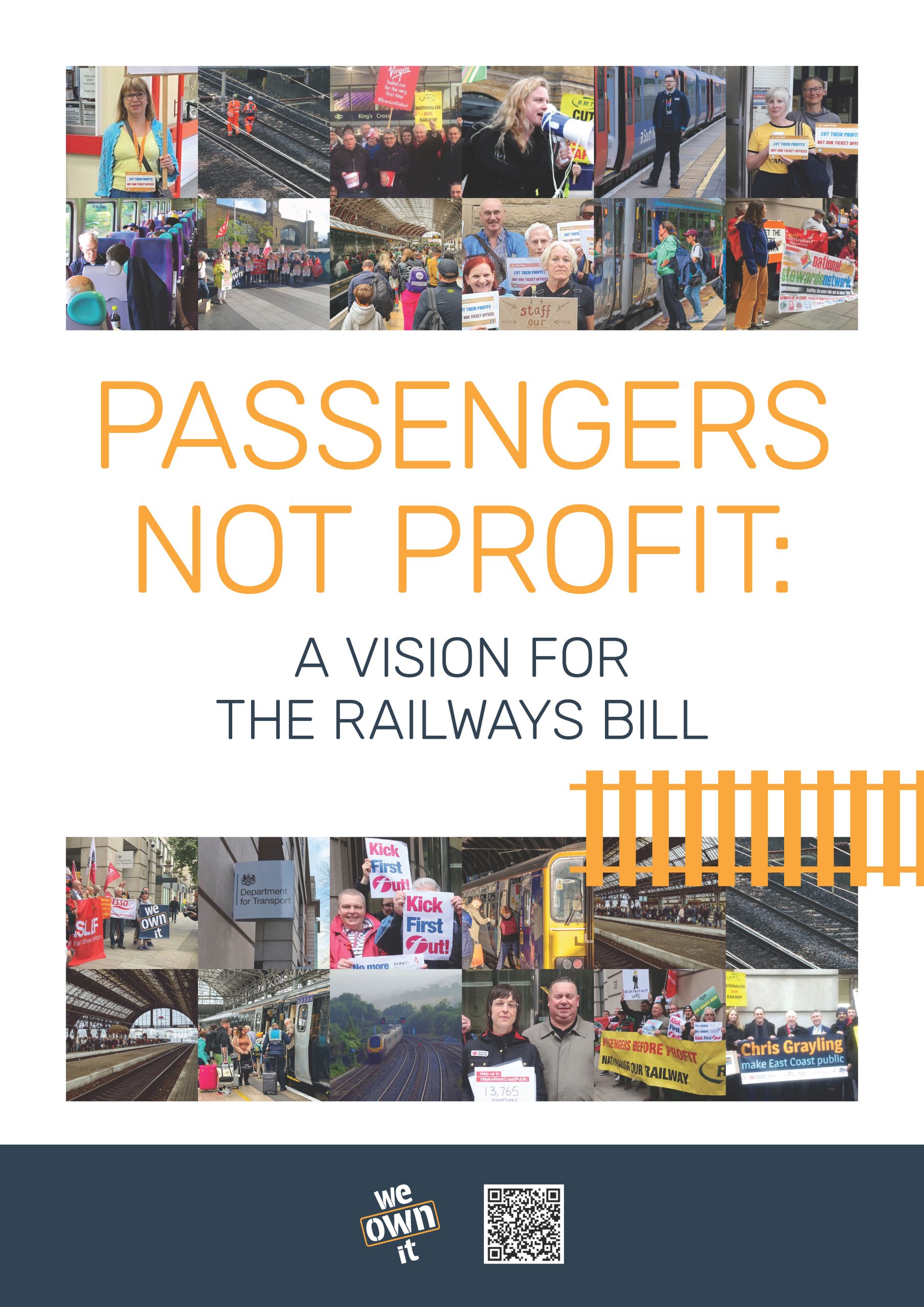
This new report published by our friends at We Own It aims to kickstart a long overdue conversation about what our new publicly-owned Great British Railways should look like, ahead of the introduction of the Railways Bill to Parliament this autumn.
It brings together rail experts and campaigners to call for a range of policies that are necessary to make public ownership a success.
These include: repealing competition law in our railways, scrapping privatised ‘open access’ services, creating a new integrated national timetable, one publicly-owned ticket retailer with cheaper and simpler fares, a new publicly-owned rolling stock company and delivering a fully-accessible railway that is run in the public interest.
This report is essential reading for all politicians and passengers wanting to understand the key issues at stake in the new Railways Bill.
New documentary on the journey to public ownership
22nd July 2025 | Media Coverage / News
Launched to mark the second rail franchise to be re-nationalised under Labour – c2c – this new documentary by young film maker Riku Fryderyk, investigates the long and complex process ahead to establish our new publicly-owned Great British Railways.
It features an interview with Bring Back British Rail founder Ellie Harrison setting out the key issues at stake when the Railways Bill is introduced to Parliament later this year.
Urgent Open Letter: Stop new private rail contracts now
15th July 2025 | News
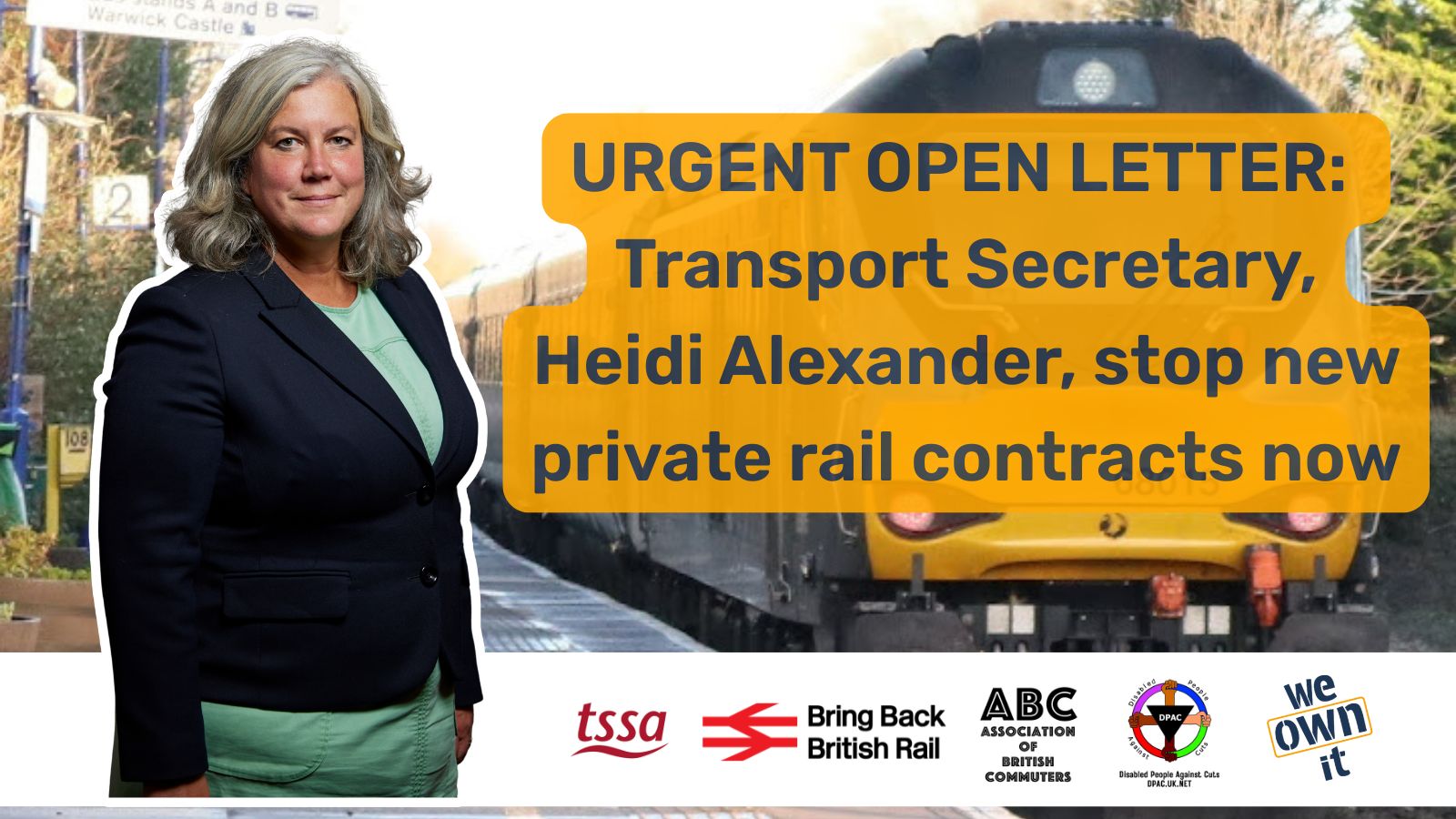
Today we sent a letter to Transport Secretary, Heidi Alexander to demand urgent action to stop the Office of Rail & Road awarding new contracts to private companies.
Allowing ‘open access’ operators to continue will completely undermine our new publicly-owned Great British Railways before it has even begun.
Ellie Harrison, Founder, Bring Back British Rail, said:
“Labour’s vision for our railways says they want passengers to feel “they are simply using ‘the railway’, not navigating a confusing network of competing organisations and interests“. They say they want to reform “the complex and fragmented fares landscape inherited from privatisation”. None of this will be possible to achieve if they allow privatised ‘open access’ operators to continue alongside Great British Railways.
“That would mean we would still have to put up with the confusion of multiple private companies selling their own tickets on various websites and apps, and all the different coloured trains sitting at station platforms, some that you are ‘allowed’ to use with your ticket, and some that you are not. Not to mention all the tedious announcements about this being a ‘Lumo’ service, and that being a Great British Railways one – it simply goes against everything these once-in-a-generation reforms are meant to achieve.”
Emily Sullivan (née Yates), Co-founder, Association of British Commuters, said:
“It is a scandal that the ORR has continued signing off these applications, using a process that is completely discredited and the government is writing new laws to fix.
“We need an urgent moratorium on open access, and then the full reform of the ORR in the public interest. This means dropping its ‘competition duties’ that only serve the interests of private companies, and instead making decisions based on socioeconomic interest and the value of public money.”
Johnbosco Nwogbo, Lead Campaigner, We Own It, said:
“The public want a fully publicly owned railway with integrated ticketing, better services and lower fares. As it stands, the Government is starting that process but must not allow any privatisation by the back door.
“Private operators are scrambling to cling on to their highly profitable routes via open access contracts. If the government allows this, it will undermine the whole project and push up fares across the board.”
Celebrating the first rail franchise to be re-nationalised under Labour
25th May 2025 | News
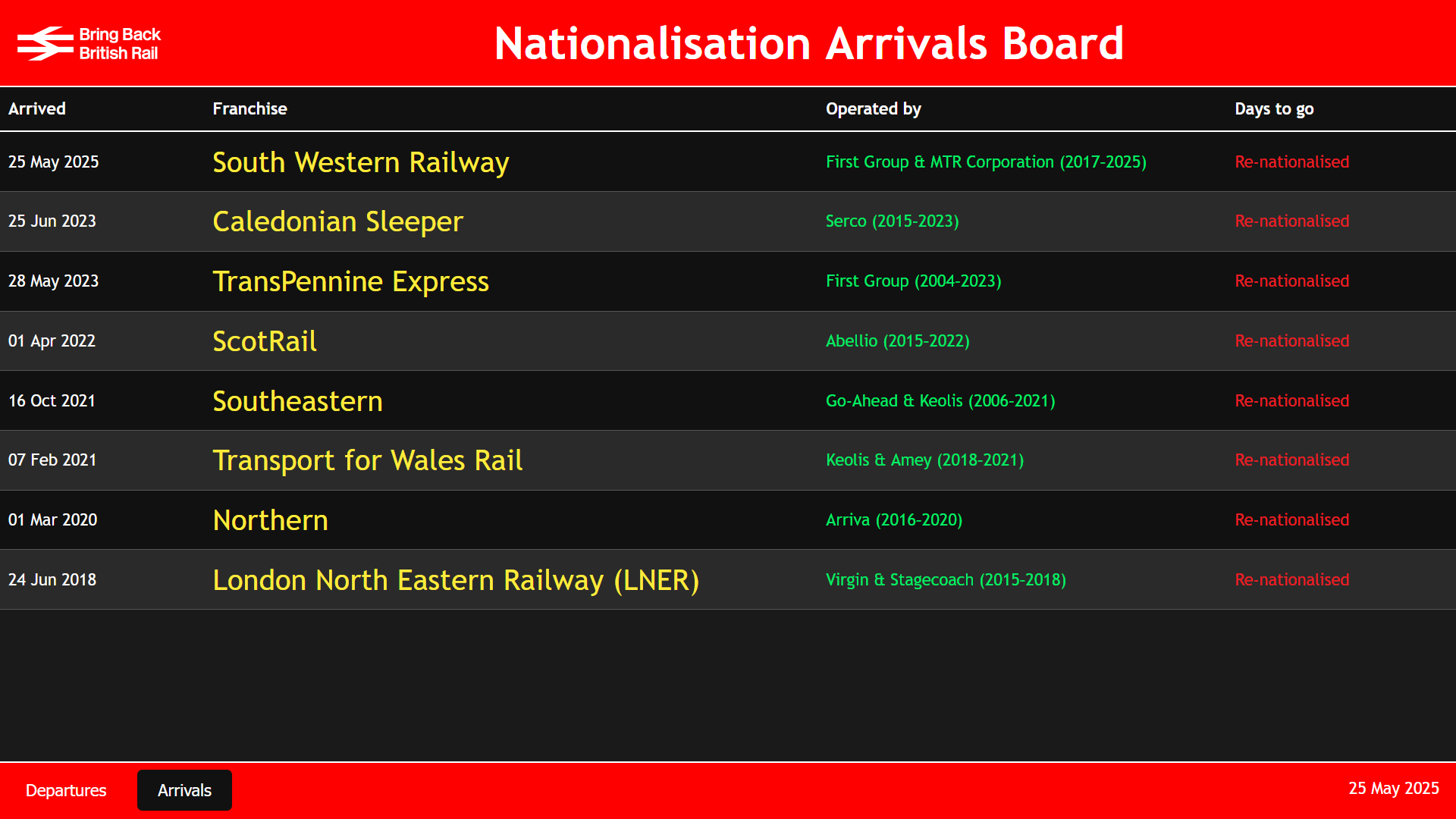
Today we welcome the first franchise – South Western Railway – to be brought back into public ownership under the Passenger Railway Services (Public Ownership) Act 2024.
You can countdown to the next ones using our nifty Privatisation Departures Board.
Privatisation Departures Board
Bringing these rail services into public ownership is just the first part of the puzzle.
Great British Railways won’t be fully created until the main Railways Bill is passed by Parliament over the next year (we’re expecting this to be introduced later in 2025).
We still have everything to play for.
Private companies have been lobbying behind the scenes for years. This has led to Labour now saying they want to enable “An ongoing role for the private sector” in Great British Railways (see p.11 of their consultation document).
This would not be proper public ownership.
If Labour continue trying to shoe-horn this into the Railways Bill (meaning the railways continue to be subject to the complexities of Competition Law), it will undermine all the key benefits of having a publicly-owned railway, including:
– a unified national timetable
– a simple and accountable structure (with less need for external regulation)
– one trusted source for all passenger information/ticketing
– cheaper fares (like Germany’s Deutschland-Ticket)
– integration with other transport modes
Please join our mailing list for updates over the next year as we continue the fight for a re-unified national rail network run for people not profit.
South Western Railway re-nationalised, how long until Great British Railways is established?
25th May 2025 | Media Coverage / News
Ellie Harrison from Bring Back British Rail was interviewed by John Stratford on LBC News to welcome the first rail franchise to be re-nationalised under the Labour government – South Western Railway – and to set out the legislative steps required before Great British Railways is established.
Let’s make Great British Railways great
10th April 2025 | Evidence / News

Demand full public ownership before the deadline on Tuesday 15 April 2025, 23:59
Last year saw a massive breakthrough for the campaign with the passing of Labour’s Passenger Railway Services (Public Ownership) Act, to bring the remaining privately-run rail franchises back into public ownership when their contracts expire.
The next step is the Railways Bill which will create the new publicly-owned body – Great British Railways – to bring together various aspects of the railways (infrastructure and passenger services) under one “directing mind”.
The Department for Transport is currently running a public consultation called “A railway fit for Britain’s future”, which will inform the Railways Bill deciding what shape Great British Railways will take.
Whilst we support the general direction of the reforms, we have serious concerns about some of Labour’s proposals which aim to enable “An ongoing role for the private sector” in our railways (p.11).
These threaten to completely undermine the core aims of Great British Railways:
- – To get rid of the “complex web of private sector operators, public bodies, industry groups, and parts of government… with competing interests, unclear accountabilities, and no overarching direction”,
- – And to replace it with “a simplified, unified structure”, “that passengers can trust” (p.8-9).
We need all our supporters to respond to the consultation to demand full public ownership before the deadline on Tuesday 15 April 2025, 23:59.
Demand Full Public Ownership
To make Great British Railways great, Labour must ensure there are no competing interests in the system, by scrapping plans for “An ongoing role for the private sector” in our railways.
Instead we need our new Great British Railways to:
- 1. Create one publicly-owned ticket retailer
- 2. End all privatised passenger services
- 3. Ensure new rolling stock is publicly-owned
- 4. Always put the public interest first
We agree that this is a “once-in-a-generation” opportunity (p.6) – we need Labour to get it right!
Below is our suggested consultation response which sets out the main reasons behind each of these demands.
If you click on the ‘Email the Consultation Team’ link above, it will open a draft email addressed to: Railreform.bill@dft.gov.uk. Please read over this, edit as you wish and add your name and address at the bottom before sending.
If you have more time, please use some of our arguments below to complete the consultation questionnaire. The more you put things in your own words the better.
Our Suggested Consultation Response
Dear Rail Reform Consultation team,
I’m writing to respond to the “A railway fit for Britain’s future” public consultation.
Whilst I support the general direction of the reforms, I have serious concerns about the proposals aimed at enabling “An ongoing role for the private sector” in our railways (p.11).
These threaten to completely undermine the core aims of Great British Railways:
- – To get rid of the “complex web of private sector operators, public bodies, industry groups, and parts of government… with competing interests, unclear accountabilities, and no overarching direction”,
- – And to replace it with “a simplified, unified structure”, “that passengers can trust” (p.8-9).
Instead, I want to see a fully publicly-owned railway, which will:
- 1. Create one publicly-owned ticket retailer
- 2. End all privatised passenger services
- 3. Ensure new rolling stock is publicly-owned
- 4. Always put the public interest first
All four of these things are vital for ensuring there are no competing interests in the system, and that we can truly have “a passenger railway owned by the public, run for the public”, “that stands once again as a point of pride for modern Britain” (p.5-6).
1. Create one publicly-owned ticket retailer
In response to ‘Chapter 5: Fares, ticketing and retailing‘ – I strongly object to Labour’s proposal “to ensure a thriving and competitive rail retail market” (p.38).
We only need one publicly-owned Great British Railways ticket retailer which is run in the public interest.
Only this can provide a “one-stop-shop” for all passenger information and tickets – via the Great British Railways website/app, and in stations at well-staffed ticket offices and vending machines.
This is the norm in most other countries with successful state-owned railways (such as Switzerland, Denmark, Netherlands and Germany).
This is the only way to fulfil Labour’s pledge to “do away with dozens of complex interfaces that currently hold the system back” (p.9).
Labour’s proposal “to ensure a thriving and competitive rail retail market” will completely undermine Great British Railway’s ability to simplify and reduce fares to encourage more rail use and help meet climate targets (such as introducing something similar to Germany’s ‘Deutschlandticket‘)
And it will allow for continued profiteering from the system by companies like Trainline – owned by private equity firms: Invesco Ltd, Baillie Gifford, JP Morgan, BlackRock and FIL Ltd.[1]
In order to rebuild trust in our railways, passengers want assurances that all the money we spend on fares is staying in the system and being used to run and improve services.
But the most crucial point is that Labour’s proposal “to ensure a thriving and competitive rail retail market” will be impossible to deliver.
This is because it will create a conflict of interest at the heart of Great British Railways – one public body simply cannot have the dual role of setting fares across the network, whilst also “compet[ing] on a fair and open basis with independent retailers” (p.37).
If the fares are set by Great British Railways there will be no competition – that is the whole point. It is competition that has created “the complex and fragmented fares landscape” that we have been dogged with since privatisation (p.36).
All passengers want is a simple, reliable, fair public retailer which we can always trust to give us the best value fare.
2. End all privatised passenger services
In response to ‘Chapter 3: Making best use of the rail network‘ – I strongly object to Labour’s proposal to allow private companies to continue to run passenger services under the ‘open access’ system (services such as Lumo and Hull Trains owned by First Group, and Grand Central owned by Arriva).
Although these services currently only make up a small percentage of the network, allowing them to continue alongside Great British Railways will have many negative consequences that will completely undermine Labour’s core aims to create “a simplified, unified structure”, “that passengers can trust” (p.8-9).
I support the plan to simplify the role of the regulator – the Office of Rail & Road (ORR) – so that it has “a more focused role centred primarily on safety and efficiency” (p.9).
However, maintaining the ‘open access’ system would mean that the ORR would also have to oversee a complex appeals process to ensure that private companies wanting to run open access services are not being “disadvantaged or discriminated against” (p.30).
This appeals process would distract the ORR from its core duties of maintaining a safe and efficient railway, whilst also giving private companies the right to sue Great British Railways if it won’t grant them access. This is obviously a really bad idea which would see millions of pounds wasted on pointless legal challenges.
Private companies are already making “record numbers of access applications” (p.25) – allowing this to continue would create a huge amount of unnecessary administration that would further waste public money.
With private companies being allowed to sell their own tickets, ‘open access’ would simply serve to maintain “the complex and fragmented fares landscape” that I have raised concerns about above (p.36).
It would also enable profit to continue to leak out of railways by permitting private companies to ‘cherry pick’ services on profitable routes: busy mainlines such as London–Edinburgh.[2]
If there is passenger demand for more services on these lines, then Great British Railways should be running them. That’s the only way to ensure that the profits from these busy routes can stay in the system and be used to cross-subsidise less busy parts of the network.
Labour says it wants “to maximise the benefits of public ownership and operation” (p.12). One of the most important of these is the ability to create a national unified timetable that works for passengers, similar to that in Switzerland and other countries.[3]
This is what will make journeys with changes so much quicker and easier and help to deliver integration with other transport modes – something that has been impossible since privatisation.
Maintaining the ‘open access’ system – giving private companies the right to sue Great British Railways – will undermine Labour’s key aim to manage “the network in the public interest on a strategic, whole-system basis” (p.10) and deliver the national unified timetable that we need.
In response to ‘Chapter 6: Devolution‘ – I support Labour’s proposal to devolve power over suburban rail networks in metropolitan areas to the new Mayoral Strategic Authorities. This must also happen in Scotland’s metropolitan areas (particularly Strathclyde) with power over suburban rail networks being devolved to the Regional Transport Partnerships.[4]
This will make it much easier to deliver fully-integrated public transport networks, across bus, tram, underground and rail in Britain’s big city-regions.
However, it is vital that safeguards are in place to ensure that devolved services cannot be re-privatised. The 2024 Passenger Railway Services (Public Ownership) Act contains these safeguards for services devolved to the Scottish and Welsh Governments, which can now only ever be run by a “public sector company”.
It is therefore a glaring oversight that services devolved to regional transport authorities (like Transport for London, Merseytravel or Transport for Greater Manchester) are not included in this Act. This must be amended or devolved regional railways could easily end up back in private hands.
It must also be the role of Great British Railways to ensure that there is coherent planning, branding and standards across devolved regional services, so that the current issues with fragmentation do not persist and that rural areas are not left behind.[5]
3. Ensure new rolling stock is publicly-owned
Another glaring oversight of the consultation is the issue of who owns the trains themselves.
This is barely mentioned at all, yet it remains one of the most dysfunctional elements of the current privatised system, with private Rolling Stock Companies (ROSCOs) making millions of pounds in profit every year.[6]
Whilst I appreciate it would be expensive to buy all the trains back in one go, we need a commitment that Great British Railways will ensure all new rolling stock going forward is publicly-owned.
This will gradually address the final part of the failed privatised system which allows significant amounts of profit to leak out to shareholders overseas.[7]
Only then will Great British Railways be able to develop a much-needed rolling stock strategy and ensure that we have high-quality trains with the best accessibility standards on all parts of the network.[8]
Great British Railways can also ensure that new trains are built in Britain creating local jobs.
4. Always put the public interest first
In response to ‘Chapter 1: Leadership for Britain’s Railways‘ – I have serious concerns that Labour’s insistence on trying to enable “An ongoing role for the private sector” in ticket retail, passenger services and rolling stock will lead to the public interest being side-lined.
In fact, research by Association of British Commuters has shown that the headline promise of the previous Conservative government that Great British Railways would be “a guiding mind… responsible for running the railways safely and efficiently to maximise social and economic value” has been shamefully scrapped from Labour’s plans.[9]
This must urgently be addressed – with social and economic value, accessibility and the environment all reinstated as statutory duties that Great British Railways must deliver.
The whole point of having a publicly-owned railway is so that it can be run in the public interest – not as a business in its own right, but as a vital tool to help our country meet our social, environmental and economic ambitions.
We must be striving to make the railway accessible for everyone in Britain, and expanding its capacity so that more and more people can use it every day.
With pressing climate targets to meet, it’s essential that we truly maximise the benefits of a fully publicly-owned railway to help shift more of our daily journeys onto public transport.
I hope that your team will take these comments on board.
[Add your name and address]
References:
- [1] November 2024, ‘On the gravy Trainline – how the ticket retailer rips off passengers and taxpayers’, National Union of Rail, Maritime & Transport Workers (RMT)
- [2] February 2025, ‘Why open access rail is incompatible with the Government’s rail policy’, National Union of Rail, Maritime & Transport Workers (RMT)
- [3] November 2024, ‘Creating a national unified rail timetable that works for passengers’, Transport for Quality of Life
- [4] October 2023, ‘Miles better: Improving public transport in the Glasgow City Region’, Centre for Cities
- [5] March 2025, ‘Where there is no vision, the people perish’, Jonathan Bray
- [6] November 2024, ‘Riding the ROSCO gravy train’, We Own It
- [7] November 2019, ‘The ROSCO racket – why it’s time to take control of UK rolling stock’, National Union of Rail, Maritime & Transport Workers (RMT)
- [8] March 2025, ‘Traction and rolling stock strategies urgently needed says former Chief Inspector of Railways’, Rail Magazine
- [9] February 2025, ‘Department for Transport drops main public interest duties from GBR, in major step back for accessibility and environment’, Association of British Commuters
We welcome Chiltern Railways being brought back into public ownership today 👏 That leaves only four rail franchises still in the private sector 🚆
⏰ Count down to their demise using our handy Privatisation Departures Board 👇
bringbackbritishrail.org/departures @top fans ...
31 CommentsComment on Facebook
View more comments
The #RailwaysBill which will create our new Great British Railways is now being scrutinised by the UK House of Lords 🚆 Can they close the loopholes for re-privatisation & help deliver a fully-integrated railway? Please read & share the Association of British Commuters' excellent briefing 👇 @top fans ...
Railways Bill Briefing 1: Ownership and Structure
abcommuters.com
The Railways Bill is supposed to be a tool for bringing the railway fully into public ownership and integrating its structure and finances. However, there is great uncertainty on both these counts,…4 CommentsComment on Facebook
View more comments
Great to see Liverpool City Region Combined Authority agree plans to take Merseyrail back into public ownership when the Serco/Transport UK contract ends in 2028 👏🚆 But there's still a big loophole in the #RailwaysBill meaning a future Mayor could easily re-privatise it 🤦♂️
Kim Johnson MP Maria Eagle Dan Carden Paula Barker MP @top fans ...
This content isn't available at the moment
When this happens, it's usually because the owner only shared it with a small group of people, changed who can see it, or it's been deleted.3 CommentsComment on Facebook
View more comments
🚨 Privatisation loopholes discovered in the Railways Bill 🚨 Last month, we thought we had a big win when the government amended the Bill to ensure that Great British Railways is fully publicly owned. But no one checked the small print… Read more from Emily Sullivan, co-founder of the Association of British Commuters in RAIL Magazine 👇 @top fans ...
Drafting issues in the Railways Bill put public ownership at risk
www.railmagazine.com
Emily Sullivan explains why the new ‘wholly owned’ requirement for Great British Railways will not deliver the public ownership Parliament expects.1 CommentsComment on Facebook
View more comments
📢 The 3rd Reading of the #RailwaysBill will now take place this 𝗪𝗲𝗱𝘀 𝟭𝟬 𝗝𝘂𝗻𝗲 🚆 Don't miss your chance to email your MP and ask them to back crucial amendments to ensure that our new publicly-owned Great British Railways always puts passengers' rights before private profit 👇 @top fans ...
Railways Bill: Demand your MP protect passengers' rights and our environment
weownit.org.uk
The Railways Bill must protect passengers' rights and our environment4 CommentsComment on Facebook
View more comments