Josie Long’s Another Planet
9th May 2015 | Media Coverage / News

What if the Railways were Renationalised?
Comedian Josie Long gives a shout out to the Bring Back British Rail campaign in her Another Planet comic strip in today’s The Guardian.
Campaign celebrates 100,000 supporters
28th April 2015 | News
The Bring Back British Rail campaign is celebrating 100,000 supporters on our Facebook page with these two back cover adverts in the General Election issues of Private Eye and New Statesman, both out this week! Go grab yourself copies and share this post using the links below.

Private Eye (back cover)
1-13 May 2015
New Statesman (back cover)
1-7 May 2015
Bring Back British Rail supports Stop TTIP
14th April 2015 | News / Petition
Bring Back British Rail together with our ‘sister campaign’ Power for the People, is supporting the self-organised European Citizens’ Initiative against the controversial Transatlantic Trade & Investment Partnership (TTIP).
TTIP threatens to make our aims of returning our essential services and infrastructure to public ownership far more difficult, by giving big corporations yet more power to sue the governments who finally wise-up to the injustices of privatisation and decide to take their assets back from the profiteers for the benefit of their citizens. Please sign the petition below before the deadline on 6 October 2015.
Rail Privatisation: A Timeline of Failures
1st April 2015 | Evidence / News
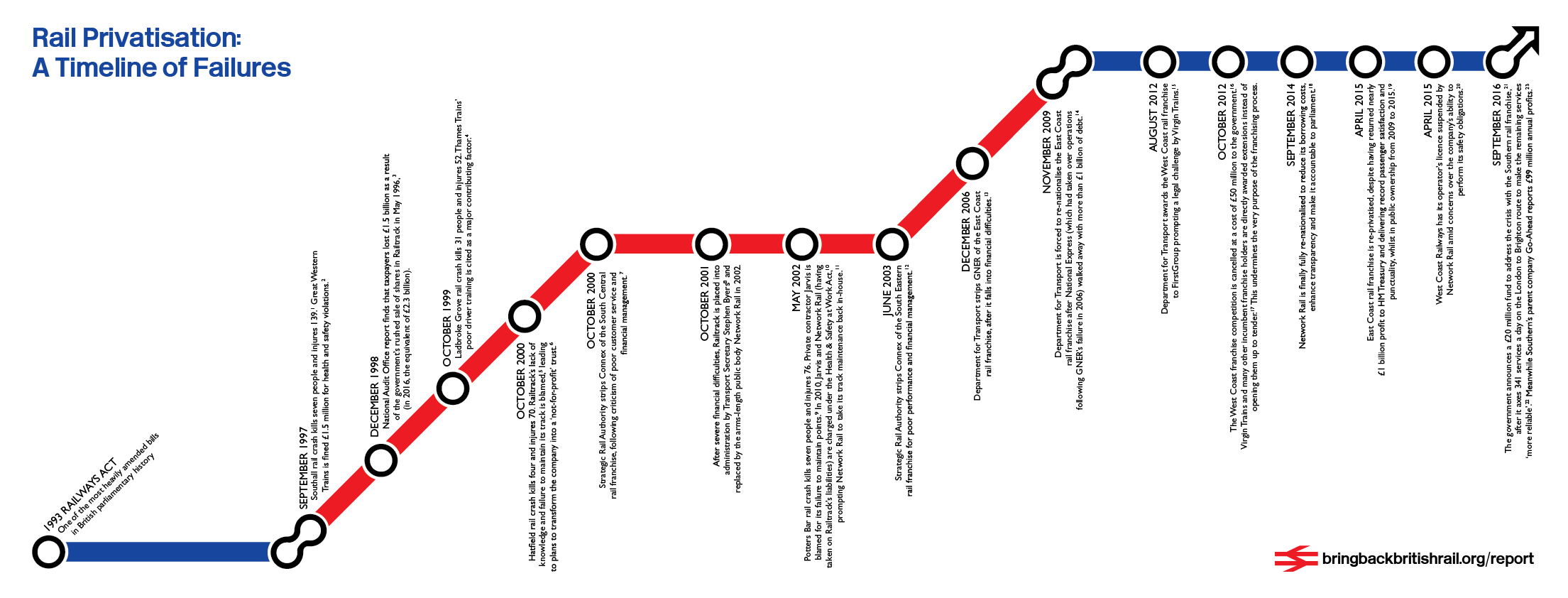
A special edited and updated version of Rail Privatisation: A Timeline of Failures (below) – based on the design of British Rail’s 1979 ‘Go Direct by Inter-City‘ poster – features in A Better Railway for Britain: Bring Back British Rail’s first report, launched in October 2016.
Today marks 21 years since the enactment of the Railways Act (1993), on 1 April 1994, which unleashed rail privatisation on the poor unfortunate public. Since then, Britain’s privatised railways have been beset by a series of failures, scandals and fatal crashes, each at great expense to taxpayers.
19 September 1997 – A collision between two trains at Southall kills seven people and injures 139. A passenger train running at high speed with defective Automatic Warning System equipment, a fundamentally important safety system, passed a signal at ‘danger’ and collided with a freight train crossing its path. Great Western Trains was fined £1.5 million for violations of health and safety law relating to this accident.
1 December 1998 – A report by the National Audit Office into the flotation of the national railway infrastructure company, Railtrack, found that taxpayers lost £1.5 billion because of the government’s decision to ignore the Public Accounts Committee’s recommendation to sell its shares in stages, opting instead to sell them all at once.
5 October 1999 – A near head-on collision between two passenger trains at Ladbroke Grove, outside London Paddington station, kills 31 people and injures more than 52. A signal with a bad safety record was passed at ‘danger’. A poor standard of driver training by Thames Trains was cited as a major contributory factor.
17 October 2000 – A train running at high speed derails at Hatfield when a rail affected by rolling contact fatigue fractures under its wheels. Four passengers were killed and 70 were injured. The crash exposed the major stewardship shortcomings of the privatised Railtrack plc and the failings of the regulatory oversight of the company (principally, failure to ensure that it had a good knowledge of the condition of its assets) which ultimately triggered its partial renationalisation. Following the crash, Railtrack imposed more than 1,200 emergency speed restrictions across its network, since it did not have the knowledge to predict where rolling contact fatigue might hit next.
24 October 2000 – Connex loses its South Central franchise after a decision by the Strategic Rail Authority to re-let the franchise following criticism of Connex’s poor customer service and poor financial management.
7 October 2001 – In the face of severe financial difficulties, Railtrack plc is placed into railway administration by the Labour government’s Transport Secretary, Stephen Byers. This leads to an explosion of costs and a severe drop in performance. Railtrack was subsequently replaced by Network Rail.
10 May 2002 – A train derails at Potters Bar, killing seven people and injuring 76. A poorly maintained set of points was to blame, the maintenance of which was the responsibility of the private sector railway maintenance contractor Jarvis (who had tried to blame the accident on ‘sabotage’). Eight years later, Jarvis and Network Rail (having taken on Railtrack’s liabilities) were both charged under the Health and Safety at Work Act. Network Rail subsequently took track maintenance back in-house.
27 June 2003 – The Connex South Eastern franchise is terminated by the Strategic Rail Authority, citing the company’s poor performance and financial management.
15 December 2006 – GNER is stripped of its East Coast franchise by the Department for Transport, having fallen into financial difficulties and unable to meet the terms of its franchise.
13 November 2009 – National Express gives up the East Coast franchise (which it had taken over from GNER) owing to financial difficulties, having accumulated more than £1 billion of debt. The failure of this franchise deprived the Department for Transport of between £330 million and £380 million of revenue.
15 August 2012 – The Department for Transport announces FirstGroup plc as the winner of the InterCity West Coast franchise, prompting the incumbent franchise holder, Virgin, to seek a judicial review of the franchise decision.
3 October 2012 – The government announces the cancellation of the InterCity West Coast franchise competition after finding significant technical flaws in the bidding process, rescinding its decision to award the franchise to FirstGroup. The Public Accounts Committee found that civil servants had made “fundamental errors” in the way that the risks for each bid had been calculated, leading to the default surety required of bidders being too low. The government reimbursed the four bidders for all costs incurred; this amounted to £39.7 million, with a further £4.9 million paid to FirstGroup as reimbursement of their mobilisation costs. In the ensuing shambles, numerous incumbent franchise holders were directly awarded extensions to their franchises instead of opening them up to tender. So much for competition!
17 December 2014 – A report from the Public Accounts Committee is severely critical of the Department for Transport’s inept handling of the procurement of new trains for the Intercity Express Programme and Thameslink. The DfT had chosen to break away from previous procurement arrangements and carry out the procurement by itself, despite having no previous experience in this area.
3 April 2015 – The private train operator West Coast Railways has its operator’s licence suspended by Network Rail amid concerns over the company’s ability to perform its safety obligations. This action followed an incident on 7 March 2015, when a steam-hauled train operated by West Coast Railways passed a signal at ‘danger’ after the driver had switched off vital train protection systems, narrowly avoiding a collision with a passenger train running at 100 mph.
Is it anyone wonder we’re all shouting Bring Back British Rail?
Spread the word! Link to this post using www.bringbackbritishrail.org/timeline and read more compelling evidence for Public Ownership here: www.bringbackbritishrail.org/evidence
Towards Public Ownership
31st March 2015 | Evidence / News

This TUC Report summarises research by Transport for Quality of Life, to show the high costs of running rail franchise “competitions” – estimated at £45million for every single one!
Given that there are 11 of these unnecessary “competitions” scheduled to take place before the next parliament ends in 2020, the Report shows how much we could save by then if we chose to run these franchises under a single publicly-owned railway company instead. It’s more than £600million!
Protests Against Privatisation
28th March 2015 | Demonstration / News

This April Fools’ Day is the 21st anniversary of the shambolic privatisation of our once world-class railways, which now wastes £1.2billion of taxpayers’ money every year.
Join Bring Back British Rail, TSSA and Campaign against Climate Change in demanding the Public Ownership of Rail at Protests Against Privatisation up-and-down the country this Wednesday 1 April 2015.
See the Facebook Event for details >
Re-nationalise ScotRail online action
11th March 2015 | Demonstration / News
Another great example of the absurdity and injustice of privatisation – on the April Fools’ Day this year, the ScotRail franchise will be handed to the Dutch state-owned Abellio, meaning Scots’ train fares will soon be subsidising railways in Holland!
As part of 48 Hour of Action for Public Ownership (on 31 March & 1 April 2015), Bring Back British Rail is launching a Thunderclap action to protest. If you use Facebook / Twitter, please sign-up to support:
Fundraising for More Days of Action!
7th February 2015 | Fundraising / News

Bring Back British Rail needs your help! We are now fundraising to pay the costs of materials / leaflets for two more nationwide Days of Action for Public Ownership of Our Railways before the General Election on 7 May.
2nd Day of Action: Wednesday 1 April 2015
Don’t be Fooled by Franchises! To mark 21 years since the enactment of the Railways Act (1993), which began this disastrous privatisation.
1st Day of Action: Friday 27 February 2015
To coincide with the second reading in the House of Commons of Caroline Lucas’s Railways Bill for a publicly owned railway that puts people before profit.
Many of the organisations we normally work with cannot pay for materials / leaflets in the run-up to the General Election because of the new draconian ‘gagging law‘. That’s why we need to do this from the ground up, by collecting small donations from Bring Back British Rail supporters all around the country.
Our goal is £2,000.
Please follow the link to donate today!
www.bringbackbritishrail.org/donate/dayofaction
RT News Interview
5th January 2015 | Media Coverage / News
Bring Back British Rail founder Ellie Harrison interviewed LIVE on RT News at 6pm on the national day of action for Public Ownership For Railways.
BBC Radio Leicester Debate
5th January 2015 | Media Coverage / News
Jonathan Lampon chairs a live debate about rail re-nationalisation with Ellie Harrison from Bring Back British Rail, Bruce Williamson from Railfuture and Ben Southwood from the Adam Smith Institute.
We welcome Chiltern Railways being brought back into public ownership today 👏 That leaves only four rail franchises still in the private sector 🚆
⏰ Count down to their demise using our handy Privatisation Departures Board 👇
bringbackbritishrail.org/departures @top fans ...
28 CommentsComment on Facebook
View more comments
The #RailwaysBill which will create our new Great British Railways is now being scrutinised by the UK House of Lords 🚆 Can they close the loopholes for re-privatisation & help deliver a fully-integrated railway? Please read & share the Association of British Commuters' excellent briefing 👇 @top fans ...
Railways Bill Briefing 1: Ownership and Structure
abcommuters.com
The Railways Bill is supposed to be a tool for bringing the railway fully into public ownership and integrating its structure and finances. However, there is great uncertainty on both these counts,…4 CommentsComment on Facebook
View more comments
Great to see Liverpool City Region Combined Authority agree plans to take Merseyrail back into public ownership when the Serco/Transport UK contract ends in 2028 👏🚆 But there's still a big loophole in the #RailwaysBill meaning a future Mayor could easily re-privatise it 🤦♂️
Kim Johnson MP Maria Eagle Dan Carden Paula Barker MP @top fans ...
This content isn't available at the moment
When this happens, it's usually because the owner only shared it with a small group of people, changed who can see it, or it's been deleted.3 CommentsComment on Facebook
View more comments
🚨 Privatisation loopholes discovered in the Railways Bill 🚨 Last month, we thought we had a big win when the government amended the Bill to ensure that Great British Railways is fully publicly owned. But no one checked the small print… Read more from Emily Sullivan, co-founder of the Association of British Commuters in RAIL Magazine 👇 @top fans ...
Drafting issues in the Railways Bill put public ownership at risk
www.railmagazine.com
Emily Sullivan explains why the new ‘wholly owned’ requirement for Great British Railways will not deliver the public ownership Parliament expects.1 CommentsComment on Facebook
View more comments
📢 The 3rd Reading of the #RailwaysBill will now take place this 𝗪𝗲𝗱𝘀 𝟭𝟬 𝗝𝘂𝗻𝗲 🚆 Don't miss your chance to email your MP and ask them to back crucial amendments to ensure that our new publicly-owned Great British Railways always puts passengers' rights before private profit 👇 @top fans ...
Railways Bill: Demand your MP protect passengers' rights and our environment
weownit.org.uk
The Railways Bill must protect passengers' rights and our environment4 CommentsComment on Facebook
View more comments